
SMALL TOWN WALKABILITY – THE BOTTOM LINE
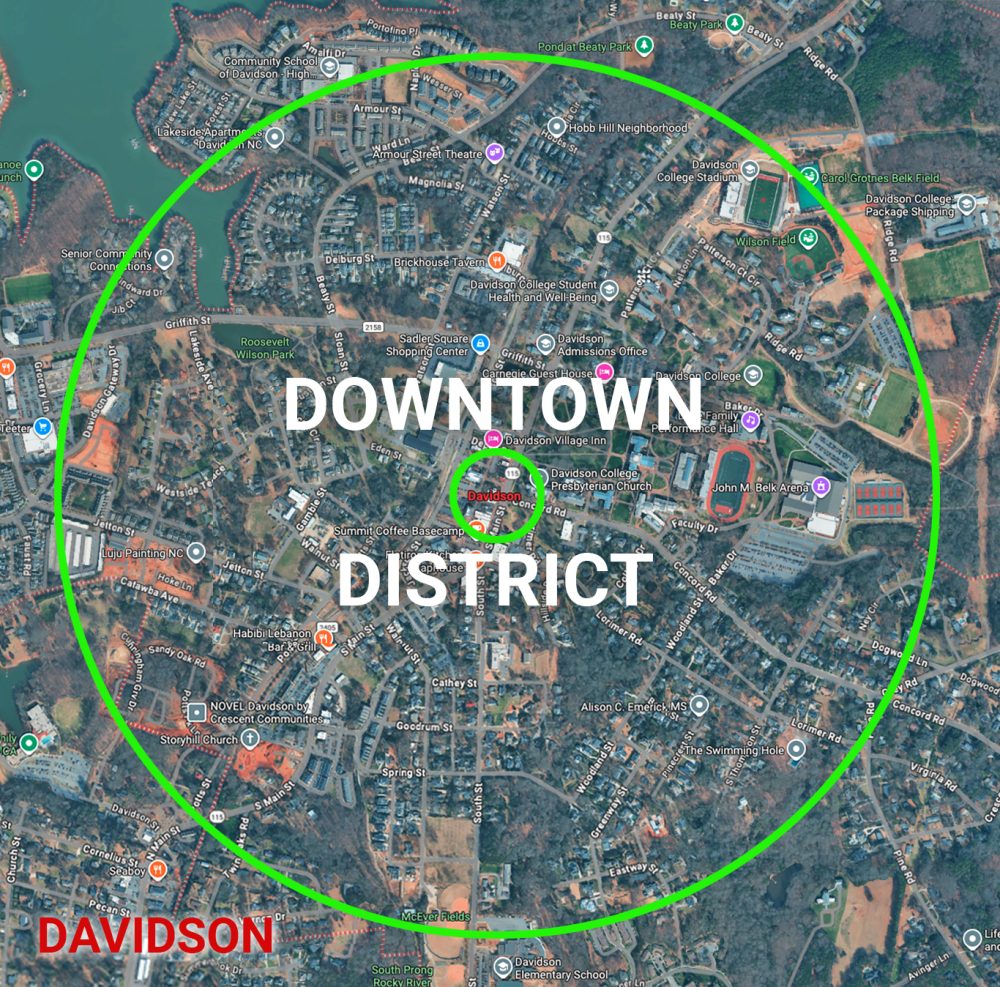
Davidson-area real estate agents, builders, and sellers routinely market homes and neighborhoods located two, three, or more miles from downtown as “walkable,” “nearby,” or “minutes from”—descriptions that blur meaningful differences in location, lifestyle, and property value. Decades of planning, transportation, and real estate research show that routine pedestrian access to community amenities (“walkability”) is generally concentrated within one-half to three-quarters of a mile. We call this three-quarter-mile zone surrounding the core of downtown Davidson the “Downtown District.” Hobbs Hill is located within this genuinely walkable zone, with Main Street, Davidson College, parks, the lake, schools, restaurants, shops, and community events all realistically accessible on foot. Homes located farther away may be convenient to downtown by car, but they are not realistically walkable. Here’s what buyers and sellers should understand—and why the distinction matters for both lifestyle and property values.
READ THE FULL ARTICLE HERE:
Davidson-area real estate agents, builders, and sellers routinely apply terms such as “walkable,” “pedestrian-friendly,” “minutes from,” and “convenient to” to homes and neighborhoods located vastly different distances from downtown Davidson. In doing so, they blur the important distinction between properties that provide genuine walkability to Davidson’s core community amenities and those located several miles away that remain automobile-dependent.
“What’s particularly interesting—and ironic—is that many of Davidson’s best-known real estate agents and builders perpetuate a contradictory message,” commented Hobbs Hill neighborhood leader and community advocate Eric Giangiordano. “On one hand, they market and assign premiums to properties genuinely located near downtown Davidson. On the other, they routinely describe homes located two, three, four, or more miles from downtown as ‘walkable,’ ‘nearby,’ or ‘convenient to’ those same amenities. It’s obvious why agents and sellers get caught up in this contradiction. Walkability and convenience increase the value of neighborhoods and homes nationwide—and for small, historic towns in urban-type locations, even more so.”
Giangiordano continued, “What’s not so obvious, and remains a largely misunderstood topic here in Davidson, is that in lower-density communities without mass transit, proximity becomes increasingly important because residents are left primarily with the options of walking or driving. True walkability must largely stand on its own. The value premium is not created by sidewalks. It is created by genuine walking proximity to the key amenities and destinations residents actually use. Even popular commercial ratings firms like Walk Score produce wildly inconsistent ratings.”
Most of the destinations that make Davidson special—including historic Main Street, Davidson College, restaurants and shops, parks, the lake, schools, places of worship, regional transportation connections, community gathering spaces, and community events—are concentrated within roughly a three-quarter-mile radius of downtown Main Street. “That concentration is one of Davidson’s greatest assets and what we are now calling the ‘Downtown District.’”
In practical terms, that radius extends approximately to Davidson Gateway on the west, Beaty Park on the north, Grey Road on the east, and Davidson Elementary School on the south (see attached map). Hobbs Hill is located inside this broader downtown walkable zone, providing practical pedestrian and bicycle access to the community amenities and destinations concentrated in central Davidson.
The planning, transportation, development, and housing industries have studied walkability extensively for decades. Although these fields have not adopted one formal national standard establishing the precise outer boundary of a “walkable” location, findings from government, academic, industry, and consumer-behavior research are remarkably consistent.
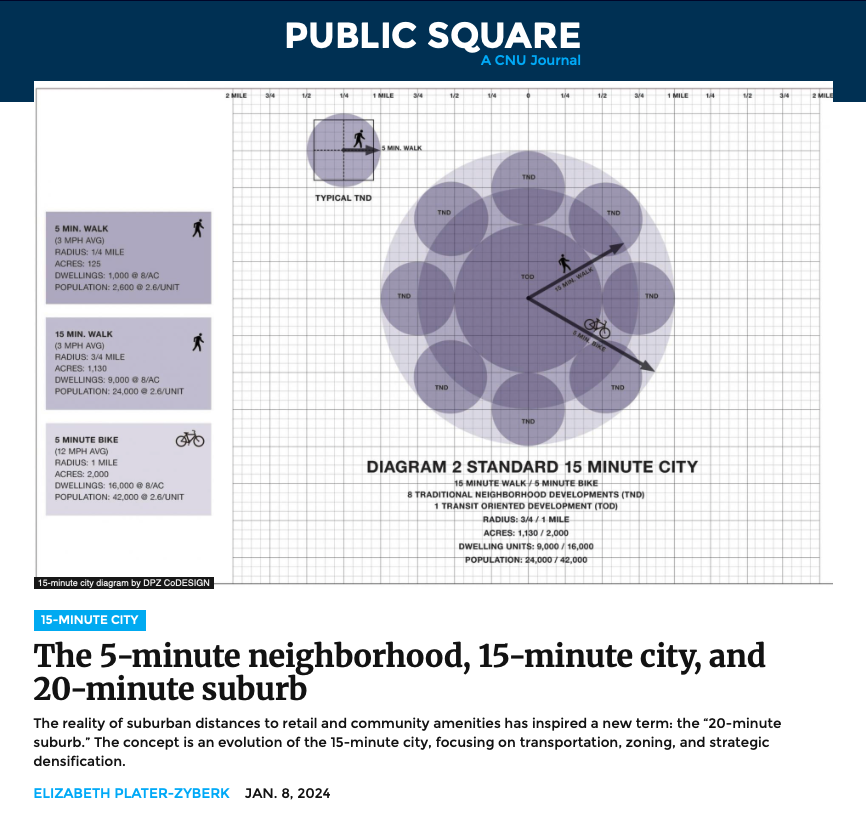
“Across numerous studies using different methodologies, routine pedestrian activity and meaningful walking access to community amenities are generally concentrated within approximately one-half to three-quarters of a mile of major destinations,” noted Giangiordano. “The Town of Davidson has also adopted a similar standard through numerous studies conducted over the past 20 years.”
As a result, a home or neighborhood located within approximately three-quarters of a mile of Davidson’s Downtown District can generally be considered truly walkable in practical, real-world terms. Destinations two, three, or more miles away may remain physically reachable on foot, but the available research consistently indicates that most residents do not routinely walk those distances to access everyday amenities. Those locations therefore function differently in terms of pedestrian usage, convenience, lifestyle, and automobile dependency.
That is the difference between a neighborhood that is genuinely walkable and one that is merely capable of being walked from.
“The issue is not whether someone physically active can walk two or three miles. Of course they can. The relevant question is whether residents routinely choose to do so as part of everyday life. Decades of planning, transportation, and consumer-behavior research indicate that most do not. That is why professional walkability studies, development plans, transit analyses, and municipal planning documents consistently focus on short walking distances rather than walks of 30 minutes or more,” observed Giangiordano.
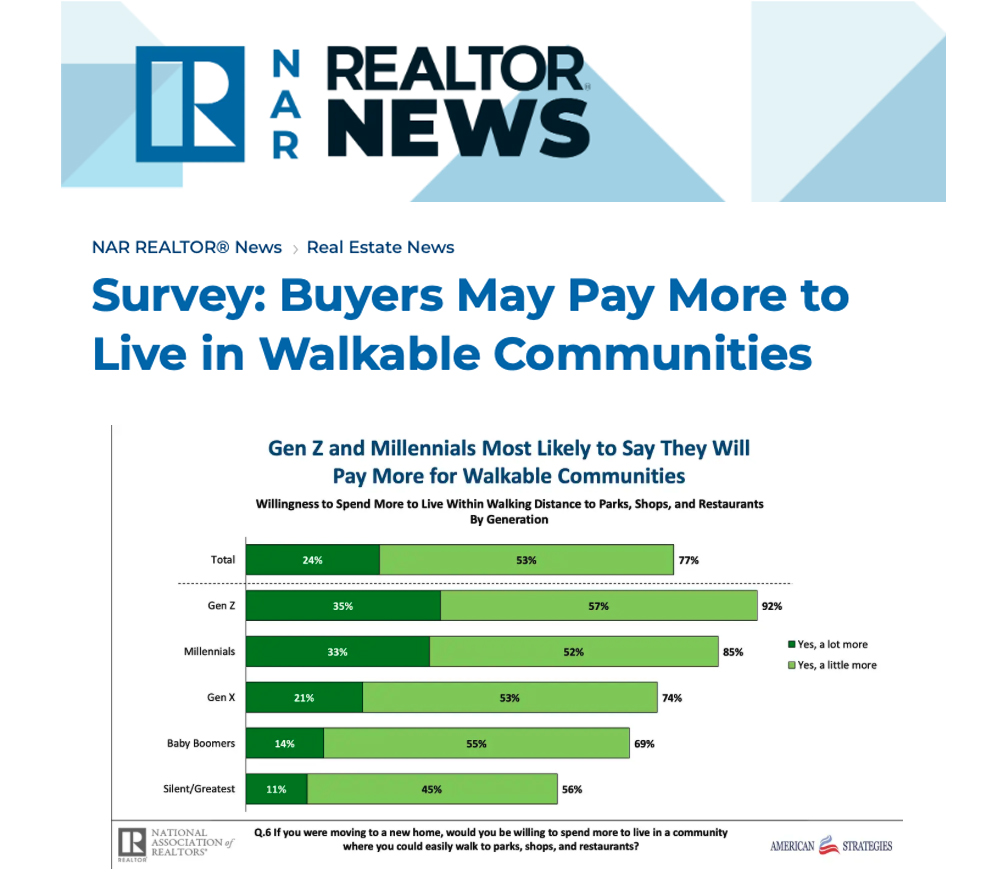
National buyer-preference surveys and real estate valuation studies also consistently show that consumers place a premium on walkability and proximity to daily-use destinations. Markets routinely assign greater value to convenience, accessibility, and proximity.
CONCLUSIONS
The evidence is clear: Homes and neighborhoods located within approximately one-half to three-quarters of a mile of concentrated community amenities function differently from those located several miles away. They provide meaningfully greater pedestrian access, convenience, and lifestyle utility.
Or, as Giangiordano noted, “In logical terms, that’s the definition of walkable, bottom line. Beyond that distance, the data are overwhelmingly clear that most people are driving, not walking. It’s ironic that while the various organizations stop short of adopting a formal industry-wide definition, the conclusions of their own studies consistently align around the same practical range.”
“That ambiguity creates a gray area that many exploit. And that is why you see real estate agents, builders, and sellers—and often buyers who simply accept marketing claims at face value—associating homes that are clearly not walkable with that term or similar adjectives.”
For buyers and sellers alike, proximity matters. Neighborhoods that provide realistic pedestrian access to daily-use destinations offer a level of convenience that cannot be replicated by comparable properties located farther away. Markets recognize that distinction, and property values should reflect it.
“At the end of the day, it’s obviously a matter of personal preference. Some people may not prioritize a walkable location, or they may prefer a more remote or rural setting. I did at another stage of my life, too. But when my family moved to Davidson to raise our child, we wanted to know the people we lived around, allow our child to play and interact regularly with other neighbors, be able to walk and bike to most Davidson attractions, and truly be part of this historic small town—and in our case, Hobbs Hill fit all those criteria and more,” commented Giangiordano.
“Speaking for many of my local neighbors, we believe that being located within the critical Davidson Downtown District—a zone walkable to virtually every major Davidson amenity—is priceless, because it’s a lifestyle factor that no realtor, study, or property appraisal is going to quantify fully. We often joke that it’s one of the reasons so many residents have remained in Hobbs Hill for 20 or 30 years, including several dating back to when the neighborhood was first built in 1993. Several residents have even moved elsewhere in Davidson, regretted it, and tried to move back.”
Giangiordano concluded with two takeaways:
“What I would tell buyers is simple: Visit Davidson. Walk it. Bike it. Experience the downtown area and community amenities firsthand, then decide what location means to you and your preferred lifestyle. After that, pull up an online map, locate the homes and neighborhoods you’re considering, and draw a three-quarter-mile radius around our historic Main Street.
“If walkability matters to you, compare two otherwise similar homes—one within the broader Downtown District walkable radius and another well outside of it. Genuine pedestrian access to Davidson’s community amenities is a premium lifestyle benefit, and buyers should expect a premium location to command a premium price. That’s a core principle of real estate across the United States.”
DATA FOR THIS ARTICLE CAME FROM VARIOUS INDEPENDENT RESEARCH, INCLUDING THE FOLLOWING SOURCES:
National Association of Realtors — Survey: Buyers May Pay More to Live in Walkable Communities
https://www.nar.realtor/news/real-estate-news/survey-buyers-may-pay-more-to-live-in-walkable-communities
American Planning Association — Walking the Walk: How Walkability Raises Home Values in U.S. Cities
https://planning.org/knowledgebase/resource/9182199/
Federal Highway Administration — National Household Travel Survey
https://nhts.ornl.gov/
CDC/Journal of Physical Activity and Health — Purpose-Based Walking Trips by Duration, Distance, and Select Characteristics
https://stacks.cdc.gov/view/cdc/113242
Congress for the New Urbanism — The 5-Minute Neighborhood, 15-Minute City, and 20-Minute Suburb
https://www.cnu.org/publicsquare/2024/01/08/5-minute-neighborhood-15-minute-city-and-20-minute-suburb
U.S. Environmental Protection Agency — National Walkability Index User Guide and Methodology
https://www.epa.gov/smartgrowth/national-walkability-index-user-guide-and-methodology
Urban Land Institute — Active Transportation and Real Estate: The Next Frontier
https://uli.org/wp-content/uploads/ULI-Documents/Active-Transportation-and-Real-Estate-The-Next-Frontier.pdf