

Today, widely regarded as the Town of Davidson’s most prominent public park, BEATY PARK holds a special relationship with both the broader community – and Hobbs Hill Neighborhood: one defined by a legacy of impact that extends far beyond its physical boundaries anchoring the northern entrance to historic downtown Davidson. That relationship is grounded in several distinguishing factors:
- Hobbs Hill is the only neighborhood directly adjoining permanently protected open space in “historic downtown Davidson” (as defined by the town’s original 1879 land incorporation)
- The only land donation contributing to Beaty Park’s open space footprint originated from the developer of Hobbs Hill
- Beaty Park is the first and only Town (publicly)-owned, natural open space in Davidson’s 180+ year history to be both independently acquired and permanently protected through a conservation easement
Equally important is how Beaty Park came to be – a public battle that dominated Charlotte and Lake Norman headlines for a year and reshaped key directions for the Town of Davidson and neighboring towns, but one that represented the culmination of nearly half a century of citizen engagement with the town. Hobbs Hill residents were not only the catalysts who first identified and mobilized on concerns regarding the sale/development of Beaty Park in 2015-2016, but also founded the 501c4 non-profit “Save Davidson” group in 2017 that led the community-wide movement that saved Beaty Park, and later were key members of the citizen task force that worked with the town to make the park a reality. Here’s a first-hand synopsis of how that history unfolded.
VISION:
Beaty Park has a uniquely complicated legacy with several chapters in the more recent history of Davidson. In 1980, Town Parks & Recreation staff, elected officials and other community advocates first publicly broached the concept of their vision to identify natural open space in the greater historic downtown Davidson area to acquire and conserve for a “future Park.” This was notable because at that time, much of that area outside the historic downtown Main Street district remained largely undeveloped – but even then, those visionary community members realized the concept of land conservation and the urgency of “acquiring land now, while it is still available.”
By 1981, the Town proceeded to identify and solicit six (6) different private landowners scattered around the East and West sides of downtown Davidson. All but one of those landowners rebuffed the Town and indicated no interest in selling their land for a community Park. Ms. Venie Clontz and her late husband Ralph had acquired a fairly significant parcel of land (approximately 50 acres) in the Northern end of downtown Davidson during the mid-century, land that historically dating back to the 18th century had been owned by key figures including the Armour family. It was prime property for future development, given it bordered Lake Davidson (Norman), North Main Street and was located just blocks from Davidson College and downtown Davidson. But Ms. Clontz and her son Ralph Clontz, Jr. were the only property owners to respond to the Town and indicate an interest in selling their land for a future public Park.
THE SALE AND DONATION OF PARK LAND:
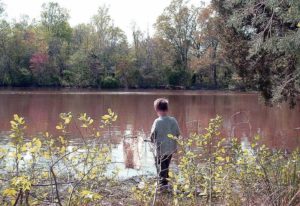
By 1985, after several years of further delays by the Town following initial offers and agreement in principal, Ms. Clontz and the Town of Davidson, under the administration of Mayor Russell Knox, finally contracted for the sale of the Eastern half of her family’s land (which had been bisected since its original acquisition by Beaty Street) to the Town for the future Park. This land conservation transaction remains historically significant because based on extensive public records research, it represents the first (and only) land parcel EVER purchased autonomously by the Town of Davidson specifically for open space/Park conservation purposes dating back to the Town’s founding in 1837! Later in 1991, developer Michael Johnson acquired lands historically owned by the Hobbs and Armour families adjacent to “Beaty Park” and began development with partner David Mayfield in 1993 of the “19 Hobbs Hill” neighborhood. In 1995, they planned to complete Hobbs Hill with a “phase 2” comprised of 5 additional lots; as a condition for Town approval, Johnson and Mayfield agreed to donate land that ultimately comprised approx. 1.5 acres of their private property to the Town expressly as open space (today known as the “Johnson parcel”), on behalf of Hobbs Hill Neighborhood. Both Johnson and Mayfield would later confirm that donation was expressly agreed to with the Town in order to serve as a buffer between Hobbs Hill and Beaty Street and be included with the Clontz property as part of the future town park. That land gifted to the Town of Davidson on behalf of Hobbs Hill Neighborhood represents the only private land donated for Beaty Park. Hobbs Hill is also the only Davidson neighborhood directly abutting Beaty Park. And as explained below, residents of Hobbs Hill started the citizen advocacy and subsequent founding of the Save Davidson non-profit that led community efforts in 2017 to save and conserve Beaty Park. So it’s easy to see why the legacies of Hobbs Hill Neighborhood and Beaty Park are forever intertwined!
DEVELOPER SPECIAL INTERESTS, RFPs & COLLUSION:

Unfortunately, over the course of the next 30 years and thru numerous changes in elected/hired Town officials, that conservation vision, agreements with the property owners and public records on the Clontz and Johnson land acquisitions for the Park were buried in town files and faded memories. Town officials in the 1980’s and 1990’s also failed to properly memorialize the defined purposes of the Clontz and Johnson land purchase and donation in legal documents filed on the parcels at the time of acquisition or thereafter as well. And as development pressures and high demand for property in Davidson escalated, development industry-skewed persons even got elected to the Town Board. The “Beaty Park” property sat completely ignored for years (other than some NCDENR-ordered repairs to the Beaty Pond/dam) while also suffering thru various Town officials’ attempts to induce development rather than fulfill the Park in its intended form; that included a “small area plan” in 1996, the first ever for the Town not coincidentally and a resulting residential development “request-for-proposal” (RFP) in 1996 that citizens protested and the Town eventually abandoned, and later a 2009 Town staff-led study targeting the property for “Eco-Industrial” development that was later not published for public knowledge. Thru all of those efforts, public records show that citizen public input on various Town studies/plans [including the most recent “Station Area Plan” (2012) and “Parks & Rec Master Plan” (2014)] consistently reiterated that the collective Clontz, Johnson and other minor adjoining land acquisitions by the Town were public property whose purpose was a community Park, with any notion for “development” to be for “public purposes” limited to the property’s NE corner (which was at the North entrance to Town of Davidson and Mecklenburg County).

A pivotal turning point in the long Beaty Park backstory occurred in early 2015, when the Town of Davidson approved a sweeping rezoning of the Beaty property and surrounding land. The change expanded allowable uses to include high-density development, including commercial, retail, and hotel options, despite questions raised by nearby residents and the fact that multiple town-sponsored small area plans over the prior decade had documented public input consistently saying the land was to be conserved as a public park.
A precursor to the 2017 community activism on behalf of Beaty park began in 2015, when one of Hobbs Hill’s residents and leaders, Eric Giangiordano, started independently investigating the Beaty property, then periodically sharing his findings and updates with neighbors in 2015-2016. He was curious why the Town had ignored the land for decades, then rezoned that area as part of the mass planning area changes adopted quietly by the Town in early 2015. Initial investigation work included reviewing public town planning documents from the previous twenty years, the legal codes known as Davidson Planning Ordinances (DPO), and town board meetings. His early work identified that various town planning documents and exercises related to the Beaty property between 1996-2014 conflicted with each other, as well as public input. The widespread assumption of local citizens (including residents of Hobbs Hill) was “the Town just hadn’t gotten around to building the park.” Armed with his initial research, he concluded that after thirty years, that explanation seemed “illogical”, and developed an alternative theory; that Town of Davidson officials had purposely ignored the Beaty property due to some non-public agenda for the disposition of that land, and possibly one that did not involve conserving it as a public park, but for what purpose?
Giangiordano’s research took a more ominous turn in the spring of 2016. To correlate his growing concerns, he contacted another long-time area resident who was much more well-connected to Town matters and officials, and both placed trust in each other to keep their dialogue confidential. He asked them to quietly explore what the town officials’ behavior and intentions were internally regarding the Beaty property. Two months later, after several follow-up attempts, he received this update: “(a senior town staffer) said there was ‘no way’ the current Town Board would ever consider preserving the (Beaty) pond and land… the parcel is on the Town’s regular list of parcels that they share with developers who are looking for land to develop in town.” That “smoking gun” substantially proved his suspicion that the Town had done nothing with the parkland, because it was keeping its options open for the tacit agenda to sell/develop the land, rather than ever create a public park: conduct that had never been disclosed to citizens, and contradicted prior public input from Town planning exercises for the prior twenty years.

In the middle of that period of research from 2015-2016, unbeknownst to him or anyone else publicly until much later in 2017, when FOIA documents were released, the situation inside Town Hall of Davidson regarding the Beaty property secretly began escalating. A local Davidson-based church, Lake Forest Church, privately approached the Town about purchasing approximately five acres at the northeast corner of the Beaty property for a new home, based on the new 2015 land rezoning, while also expressing support for the long-promised creation of a public park on the remaining land. But instead of advancing that vision, Town officials shelved the church’s proposal and used their inquiry as a springboard to formally pursue the town officials’ broader development agenda once and for all.
In August 2016, the Town managers, under the direction of the Mayor and Board, suddenly issued the “Beaty RFP (request-for-proposal)” developers interested in purchasing and developing the Beaty property – despite knowing the town’s express and implied agreements with the Clontz and Johnson/Mayfield families for public parks & recreation use of the land the town acquired from them, citizens’ rejections of previous such RFPs, and zero public discussion or input on that RFP. The Beaty RFP included extensive firm requirements that omitted numerous other legally permissible zoning uses, clearly establishing that high-density, mixed-use commercial development across the entire 20-acre property was the primary purpose of the RFP. Town leaders asserted that the plan would “still include a park,” yet residents argued any such “park” would largely consist of minimal land already restricted by watershed and open space laws, centered around the existing Beaty pond—areas that were impractical or legally impossible to develop anyway.
A “VOCIFEROUS NEIGHBORHOOD” AND CITIZEN UPRISING TO “SAVE THE PARK… AND TOWN”:
In response to the Beaty RFP, Hobbs Hill residents organized and mobilized. In September and October 2016, Giangiordano organized neighbors into the Hobbs Hill Neighborhood Alliance (HHNA) and led a series of meetings with Town officials to question the RFP and better understand the Town’s now-clear intent to sell and develop the land. Hobbs Hill neighbors then began communicating with residents of the adjacent North Main (NoMa) neighborhood, who lived on the opposite side of the Norfolk-Southern railroad line from the Beaty property and Hobbs Hill.
After initial neighborhood and citizen pushback to the RFP, the Town responded by forming a “Beaty RFP Selection Committee,” composed of town staff, elected officials, and citizens, with the purpose of reviewing the proposals submitted by developers. Giangiordano and NoMa resident Stephanie Amadio were appointed to the committee after firm requests were made, in part because Hobbs Hill and NoMa were the two neighborhoods closest to the property, and at that time, represented the citizens with the most familiarity with the Beaty property.
As that committee process unfolded in January 2017, serious concerns emerged about speed, transparency, and fairness. 4 of the 6 RFP proposals were eliminated in the first 2-hour meeting. The process moved quickly toward selecting a finalist by the third and final meeting, despite widespread objections. Subsequent FOIA public records requests later revealed extensive private communications and even in-person meetings that occurred between Town officials and representatives of their favored developer, Davidson Development Partners, including collusion in the months to follow on messaging and responses to citizen criticism. One particularly infamous email communication from a DDP partner referenced Hobbs Hill residents as “vociferous,” reflecting the growing adversarial posture of Town leadership and the developer, collaborating against concerned citizens – a clear violation of accepted standards and practices.
Giangiordano and Amadio coordinated between their neighborhoods to submit written protest letters to the Town, requesting a pause of the RFP, reevaluating the process, and seeking public input. Town officials refused, so at the final one-hour committee meeting, they both publicly abstained from voting in protest. The committee nevertheless hastily voted 3–2 to endorse DDP’s “Luminous” proposal – the most aggressive plan submitted, involving high-density housing, roads, commercial development (including a hotel), and only minimal open space around the pond (which would be used as a stormwater control for the development) to meet town and County environmental ordinance requirements. Following the committee’s conclusion, they noted numerous flaws with the entire process; for those interested, a breakdown of that and many other complex topics, including planning code, historical documents, and the legal process behind the entire Beaty RFP and Park controversy, was discussed in this Save Davidson podcast: https://www.youtube.com/watch?v=CH6LWXQAgYE&t=1713s.
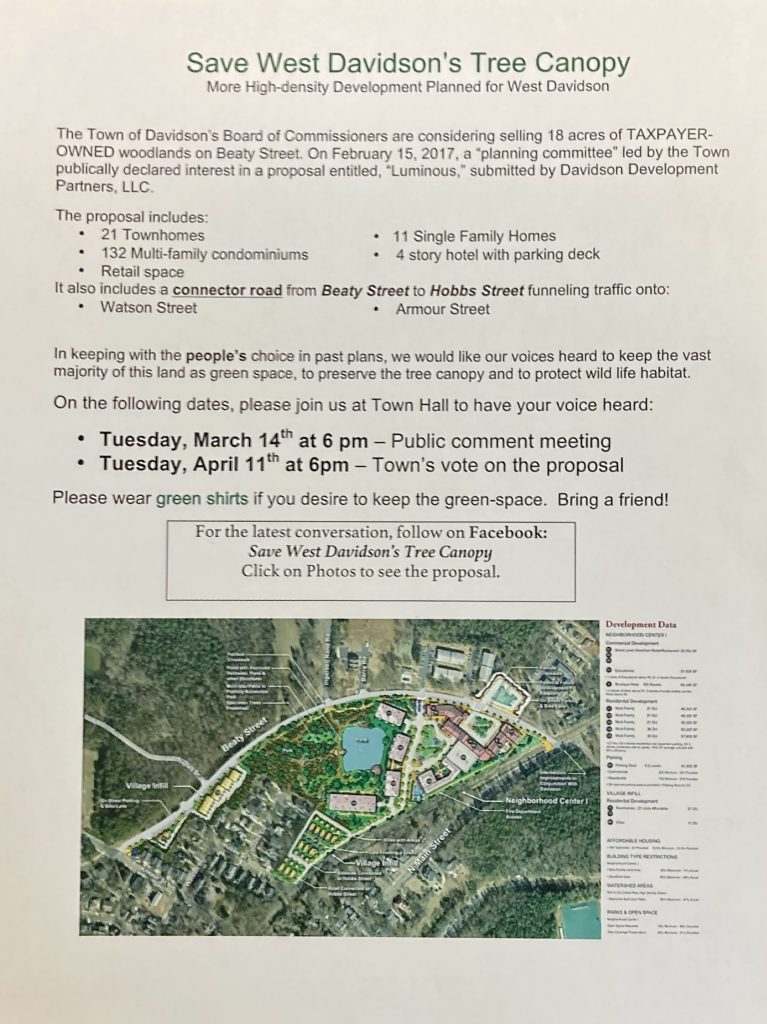
The Hobbs Hill and NoMa neighborhoods, together with a handful of other residents who played critical roles, including Heidi Dietrich, recognized that their efforts were at a crossroads. As the exchange of email warnings and ideas increased between neighbors during the first two weeks of February 2017, it was clear HHNA and NoMa’s good-faith efforts were insufficient, and that only broader Davidson community awareness and action could stop the sale and redevelopment of Beaty Park (the Town stated an intent to sign a binding contract quickly in less than 90 days). Giangiordano emailed neighbors on February 3, 2017 to make the gravity and urgency of the situation clear, issuing what in effect became the “call to arms” to residents, stating “Irrespective of this (Beaty RFP) selection committee process, which I feel is compromised, we are going to need to start discussing how to ramp up a targeted plan of attack on objective issues… this is going to require an aggressive, objective and multi-pronged strategy involving all of us, but also more importantly engaging participation/support of the neighboring residents/neighborhoods and town-wide key influencers… start by asking each of ourselves “What are you prepared to do?”
Within days of those email exchanges between neighbors the first week of February 2017, Hobbs Hill residents Denise and Ben Beall made a fateful decision that would change the course of the battle to save Beaty Park, and alter history in Davidson: while coordinating with other neighbors on initial activist ideas, they created a Facebook group called “Save West Davidson’s Tree Canopy” – later shortened to “Save Davidson” – which over the next 45 days would rapidly became the primary public platform for organizing citizen awareness and activism. It marked a dramatic shift from several dozen to several thousand citizens fighting the battle to save the park. Save Davidson’s motto is “Educate. Engage. Advocate. Activate.” and its mission statement is “to preserve Davidson’s small-town quality of life by educating and engaging citizens in Town governance, community advocacy, and activism.” For more information, visit https://www.savedavidson.org/ or the Facebook page that started it all: https://www.facebook.com/groups/SaveDavidson
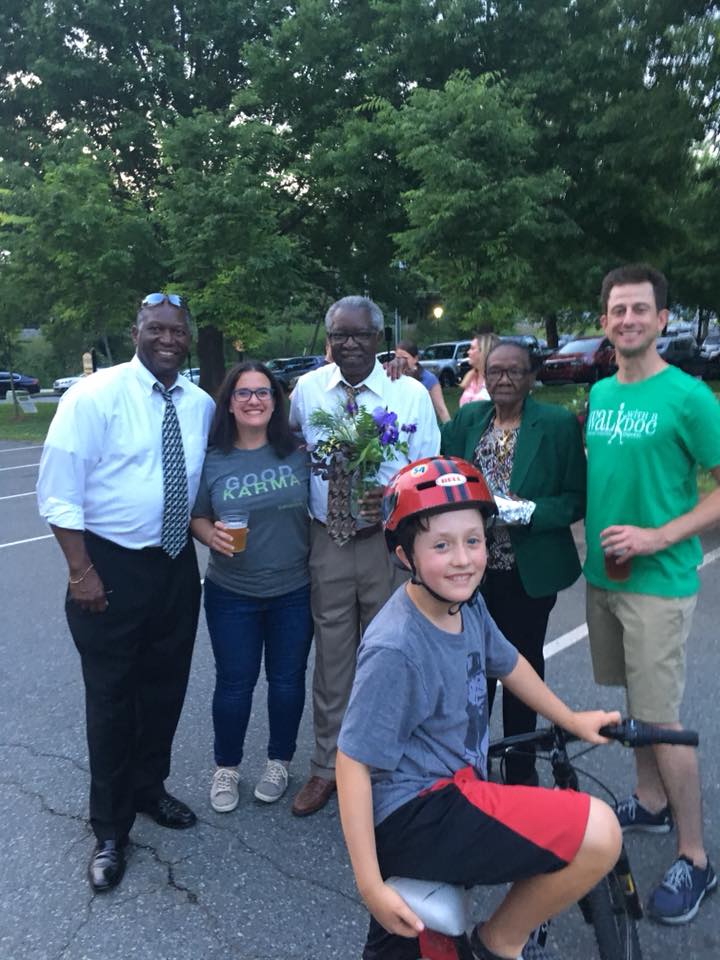
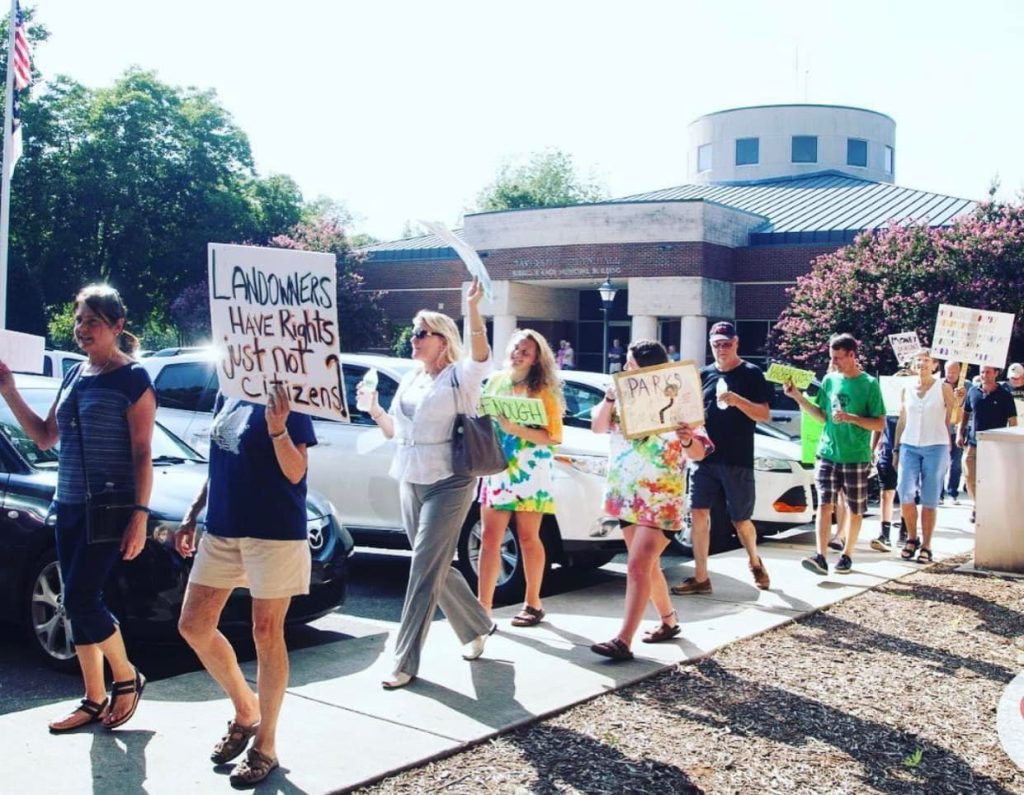
The Facebook group provided an ideal community engagement forum for the “call to action”, but Save Davidson was far more than just a social media platform. Working with a diverse group of other volunteer supporters, the organization quickly established itself as grassroots, while also operating very professionally, launching a website and developing the iconic green “Save Davidson” logo seen on apparel and yard signs throughout town. They organized public information and fundraising events that helped drive education on municipal projects far beyond just support for Beaty Park. Future board of directors member Donna Pollack (also a Hobbs Hill resident) took the lead on critical tasks like FOIA (“Freedom of Information Act) document requests and related research; board member Jana Watt helped lead engagement in the East Davidson region. Save Davidson grew quickly, fueled by concern not just over Beaty Park, but frustrations now being shared transparently and publicly for the first time about Town Hall behavior and decision-making beyond just Beaty Park. Citizen anger was mounting over numerous other controversies, including the Mi-Connection town-owned cable debacle that cost taxpayers over $70M in losses, the controversial RedLine regional rail transit plan, and equally controversial Interstate 77 NCDOT-Cintra toll lanes, all municipal projects endorsed and led by Davidson officials, including the Mayor. Longtime Davidson community advocates like Rick Short and numerous regional County, Parks & Rec, and State leaders also lent critical support. Short, in particular, was a key resource after years of monitoring town municipal actions and publicizing them in his popular blog. Citizens across Davidson from all walks of life, children to retirees, were coming together to attend Save Davidson events, join public marches in protest, and pack town board meetings on a scale that hadn’t been seen in the Town of Davidson in generations. In early summer, the Bealls and Save Davidson Board, realizing the upcoming 2017 elections represented perhaps the best opportunity to truly “Save the park, and town”, formally registered the organization as a 501(c)(4) nonprofit – not only would this allow Save Davidson to advance its mission of civic education, transparency, and citizen engagement, but the registration legally allowed the organization to endorse and campaign for candidates for political office.
Due to its immense popularity and small six-square-mile total jurisdiction, Davidson had undergone significant changes in recent years. In addition to all of those major regional municipal controversies that Davidson officials put themselves in the middle of, high-density commercial, mixed-use, and residential development pressures created an environment where development controversies seemed to highlight nearly every Town of Davidson monthly board meeting. Critics of Save Davidson were largely comprised of older, long-time residents, many of whom were members of special interest groups or stakeholders with vested interests in Davidson land development; many had steered town politics for decades with their votes and influence – the “old guard regime,” to use a popular term coined by Giangiordano. The old-guard’s most common criticism of supporters of Beaty Park and Save Davidson was “anti-development or progress.” That was false, given the fact that even the Hobbs Hill and NoMa neighborhoods had acknowledged that “some” development on the northeast corner of the Beaty property was an option, and that statistically, most supporters had lived in Davidson for less than 10 years. It was also ironic since several members of the Town Board were active builders/developers in Davidson, yet Save Davidson and the majority of citizens at large never lobbied for “no development.” Instead, they were simply demanding a more sensible, balanced, and transparent approach to municipal actions, including development, to help preserve the character of Davidson that makes it unique.
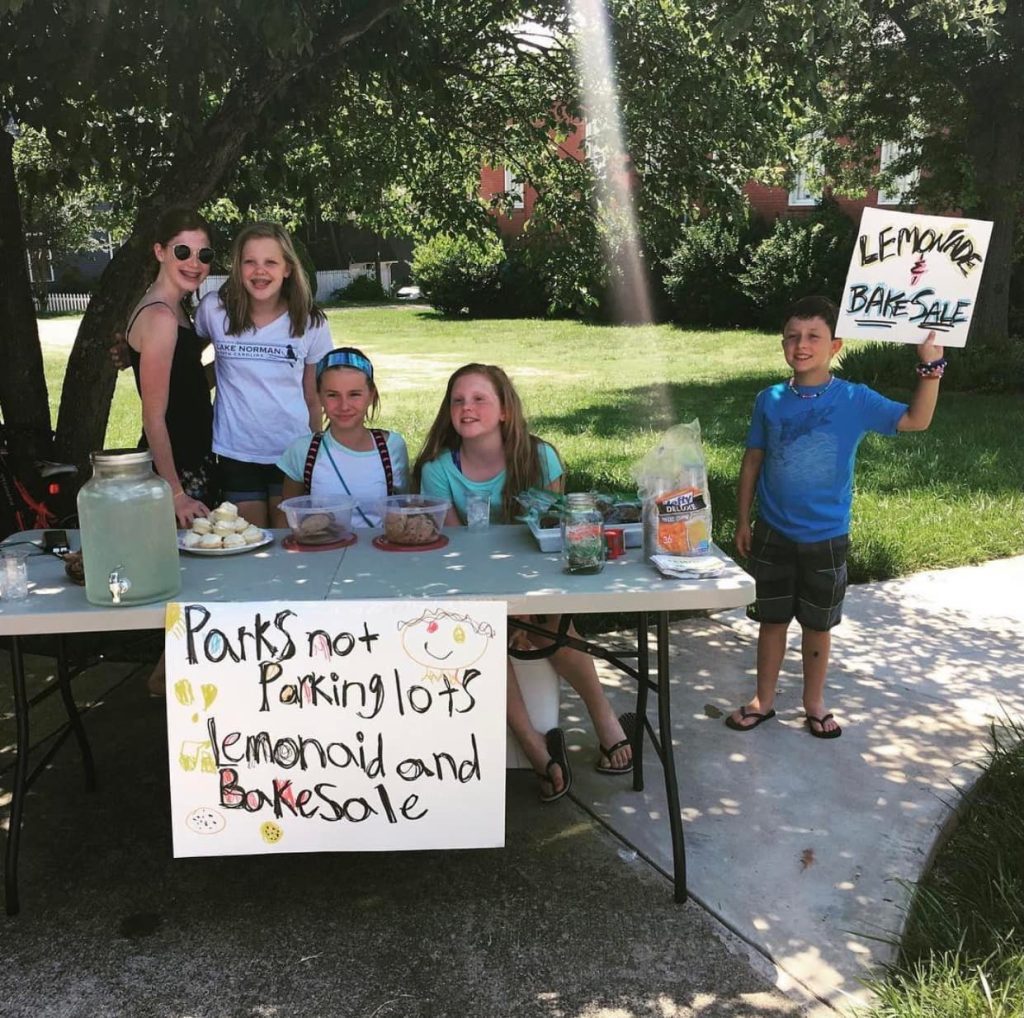
Overall, many citizens had grown weary of the indifference in town hall being demonstrated towards voters and taxpayers, combined with an escalating pattern of controversial behavior by the Town officials, including conditional rezoning, approvals for high-density development projects inconsistent with existing infrastructure or town plans, frequent closed session meetings, and a growing pattern of lawsuits between the Town and area developers. While those town elected and appointed representatives had accomplished many positive things for Davidson in prior years, descriptions like “lost their way” and “conduct themselves in an echo chamber” summarized the view of many. As open public discussion about that “old guard” in Davidson grew louder across neighboring North Mecklenburg County towns, even other highly respected elected officials, like NC State senators Jeff Tarte and Natasha Marcus, Mecklenburg County Commissioner Jim Puckett, and Mecklenburg County Parks & Rec Director Jim Garges. Two of the Town of Cornelius’ most respected Commissioners, Dave Gilroy (who led Cornelius’ decision to stay out of the Mi-Connection telecom debacle) and Kurt Naas (a leader of opposition to the Cintra-NCDOT I77 Tolls contract), both expressed support for many of Save Davidson’s initiatives, including saving Beaty Park. They also reminded citizens of critical misjudgments Davidson’s officials kept making on key regional projects, regardless of feedback, often referring to that culture as the “Davidson bubble.”
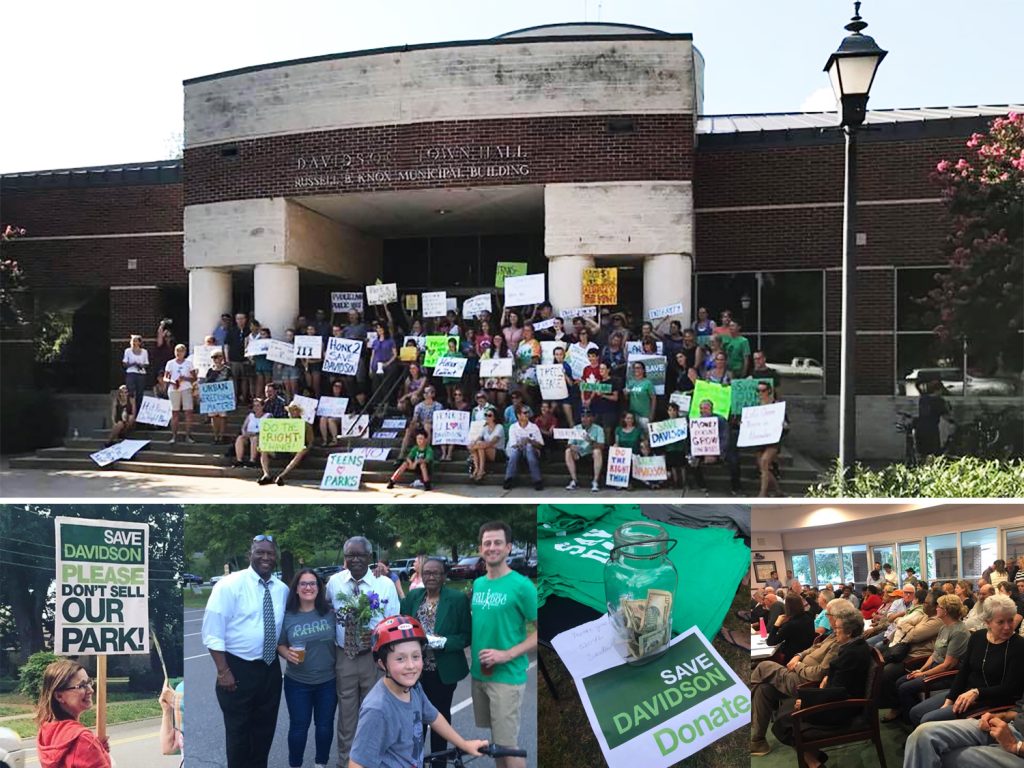
Public opposition to the Beaty RFP and other controversial Town decisions intensified throughout 2017, thanks to Save Davidson’s initiatives and growing community activism. Town officials attempted to appease critics by finally organizing the first “public input session” on May 17, 2017, regarding the Beaty property, the most highly attended such event in modern Davidson history. Citizen feedback overwhelmingly rejected the RFP sale/development agenda and affirmed voters’ desire for the property to be the public park it had always been promised, with any development limited to the area near Beaty/North Main Streets (like the solicitation made by Lake Forest Church). Unfortunately, Town officials refused to acknowledge their misdeeds and mostly disregarded even the results of their own public input session.
Another pivotal moment occurred the following week at the May 23rd Town board meeting; attorney Ralph Clontz, the grandson of Venie Clontz, had been contacted by Denise Beall and Heidi Dietrich about the Town’s RFP and plan to sell and develop the land his grandmother (Venie Clontz) had sold to the town three decades earlier, expressly for a public park. Clontz, an accomplished Charlotte attorney, made an unannounced appearance at the packed town hall meeting, was recognized by Commissioner Jim Fuller, and provided powerful and transparent testimony that directly refuted dozens of public record statements by Town officials. In another famous remark, Clontz politely chastised the Davidson board about reneging on the Town’s commitment to make his grandmother’s land a public park, saying that was “bad karma,” which is where the popular “Good Karma” motto for Save Davidson and Beaty Park originated.
As months passed and Save Davidson’s community impact spread with the November 2017 election looming, the climate surrounding the incumbent town officials grew far more heated and controversial than anyone could have imagined. Some of those officials and their loyalists sadly began resorting to “dirty politics”, stealing Save Davidson yard signs, spreading false rumors about Save Davidson and its founders/directors, issuing unsubstantiated statements related to Beaty Park and other town decisions, and even briefly filing a lawsuit against Save Davidson in a move to discredit the organization, which was quickly dismissed for lack of merit. All of those actions further upset voters across the region in many towns, not just Davidson, drawing even more public attention from people asking, “What is going on in Davidson?!” For many Davidson residents, new and old, the uncivil and even potentially criminal behavior seemed to reinforce their understanding of the types of behavior that had been going on for years privately, due to a mix of dubious character and public apathy. Other felt it illustrate how desperate the “old guard regime” was to avoid losing its decades-long grip over Davidson politics, including zoning and development agendas.
Town officials then proceeded with an “independent” appraisal of the Beaty property as one of their final steps to contract the sale of the land to DDP. That entire property appraisal process created yet more public controversy, with Save Davidson supporters and new candidates running for office, including David Sitton, documenting more flaws with the town’s appraisal process. Save Davidson even commissioned its own separate professional property appraisal that refuted the valuation and other aspects of how the Town manipulated its appraisal. Facing overwhelming public record evidence that proved town officials had repeatedly misstated facts about the Beaty property (and in some cases, lied), citizen protests, and widespread regional rebuke, in August 2018, the Town of Davidson finally abandoned its attempts to execute a contract with officials’ chosen developer for the sale of the property – Davidson Development Partners, thus temporarily “saving the Park.” But those same officials again shocked citizens by attributing their issues to an “inability to reach mutual agreement with the developer on the contract” (rather than citizen protests about errors/misdeeds), and stated that “other uses/future development remained a possibility.” Public comments at town board meetings continued to be harshly critical of the Mayor, Commissioners, and senior staff. At one Town board meeting, Commissioner Rodney Graham stunned the audience in response to such criticism, telling citizens that if they didn’t like how he and his fellow elected officials were behaving, they could voice their opinions via the election in November. It exemplified the tone-deaf behavior that reinforced to most citizens why major changes were necessary in Town Hall, and further eroded citizens’ trust in the existing entrenched leadership of Davidson, particularly the contingent of elected officials whose business and fiduciary interests frequently involved zoning, construction, and land development projects in Davidson.

In September 2017, Save Davidson organized and hosted the Town’s most well-attended 2017 Mayoral/Commissioner candidate forums. All of the candidates were equally welcomed, providing a neutral environment for discussing the issues unifying and dividing voters. Like every Save Davidson community event in 2017, the forums were conceived and organized by the group’s directors and core members, but exemplified the “it takes a village” philosophy by relying on dozens of the most active supporters of the cause to volunteer their time and various skillsets to make such events happen. Capably moderated by Save Davidson supporters Callan Bryan and Stephanie Amadio, the SavDav election forums garnered seemingly unanimous agreement from candidates and voters of being one of the most professional election forums in the history of Davidson. Save Davidson had helped motivate numerous first-time candidates from locations all over town to enter the Davidson elections. Of the two (2) new Mayoral candidates and nine (9) new Commissioner candidates, in various forms, ALL opposed the RFP and proposed sale/development of Beaty Park, noting the flawed process, lack of public input, and overwhelming citizen support to honor the original Park promise. Public opposition to the Beaty RFP and other controversial Town decisions intensified, while the public protests and other advocacy led by Save Davidson were making news headlines across the Lake Norman and Charlotte area.
On November 7, 2017, a year of public advocacy and engagement thanks to thousands of hours of volunteer and pro bono work by Save Davidson founding members and hundreds of the most dedicated supporters, culminated with the citizens of the Town of Davidson turning out in historic numbers (over 300% higher voter turnout than the last election) to support new candidates, including those endorsed by Save Davidson. Voters ousted the long-time Mayor John Woods and 4 of the 5 incumbent Board of Commissioners, who voters deemed responsible for the Beaty RFP, and many other highly controversial decisions (Rodney Graham, Brian Jenest, Beth Cashion, and Stacy Anderson, noting that Jenest and Cashion opted not to even attempt running for re-election). Voters also overwhelmingly approved $15M in new municipal bonds to fund mobility, greenway, and parks and recreation projects: taxpayer support that was clearly conditioned upon being managed by a new slate of elected town leaders. The sole incumbent Commissioner re-elected was attorney Jim Fuller, who had voted against the sale of the Park and consistently joined citizens in opposing many other projects advanced by his peers during 2016-2017. Voters had spoken clearly through our American democracy, demonstrating an overwhelming mandate for substantive changes in how the Town Hall of Davidson conducted the business of its citizens. The majority of Davidson residents signaled that the old “Davidson bubble” and all of the negativity associated with it, including lack of accountability and transparency, would no longer be tolerated. Political and mainstream news media also noted that voter turnout and engagement were historically higher in other Lake Norman towns, too, attributing much of that positive influence to Save Davidson’s efforts.
BEATY PARK – 4 DECADES IN THE MAKING:
Following that historic 2017 election and citizen mandate for sweeping changes in Town Hall policy and core values, new Mayor Rusty Knox (notably the son of Mayor Russell Knox, who had signed the Town’s original contract to purchase the park property from Ms. Venie Clontz) and the new Board of Commissioners (David Sitton, Matthew Fort, Autumn Michael, Jane Campbell and Jim Fuller) promptly appointed a diverse citizen-led “Park at Beaty Street Task Force” that worked in partnership with the Town’s Parks & Rec Director to oversee an unprecedented year-long public input, analysis and design process for the Park. Several residents of Hobbs Hill served on that committee. It should also be noted that in their first terms, the new officials saw the resignations of several senior town staff, including the town attorney and assistant town manager (who had authored the Beaty RFP). The new Board also advanced dozens of other critical corrective actions and new projects that Save Davidson and voters had prioritized. Commissioners Sitton and Forte led the long-overdue divestment of the money-losing Mi-Connection/Continuum business. The restoration of a historic school into the new Town Hall, new Police and Fire Stations, additional new mobility, greenway, and park projects, and many other changes, large and small, in every part of Davidson. In helping save Beaty Park, Save Davidson supporters truly empowered their neighbors to recognize the value of civic engagement in saving or advancing initiatives that will have positive impacts throughout the Town of Davidson for generations to come.
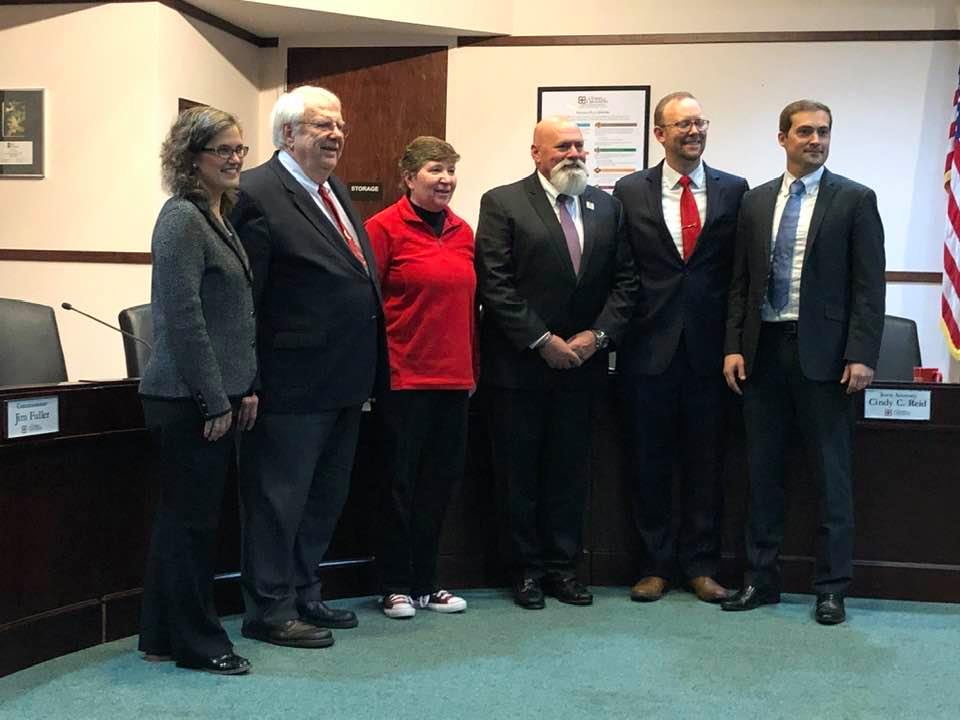
In February 2019, the Park at Beaty Street Task Force presented a final master plan and comprehensive strategic recommendations, including calling for a permanent conservation easement to protect/conserve the Park in perpetuity. Several citizens, including leaders of Hobbs Hill, lobbied the town and task force for the conservation easement, noting “case law proved that was the strongest legal measure to permanently protect the Beaty property, and ensure that regardless of any future politics and special interest agendas, the community would never have to fight to save the park, again.” On March 19, 2019, the Board unanimously voted to approve the task force recommendations, marking the first time since 1985 that the Town of Davidson had officially recognized the original stated purpose of the Clontz property as publicly-owned open space and a Park, and placing the property under the responsibility of the Town’s Parks & Recreation Department. In July 2019, the Board voted with citizen input to officially name it “Beaty Park”, with a dedication to the Clontz family, and in August 2019, the Town approved and executed a proper permanent conservation easement for Beaty Park with the accredited Davidson Lands Conservancy, a leading local conservation group.
LOOKING FORWARD:
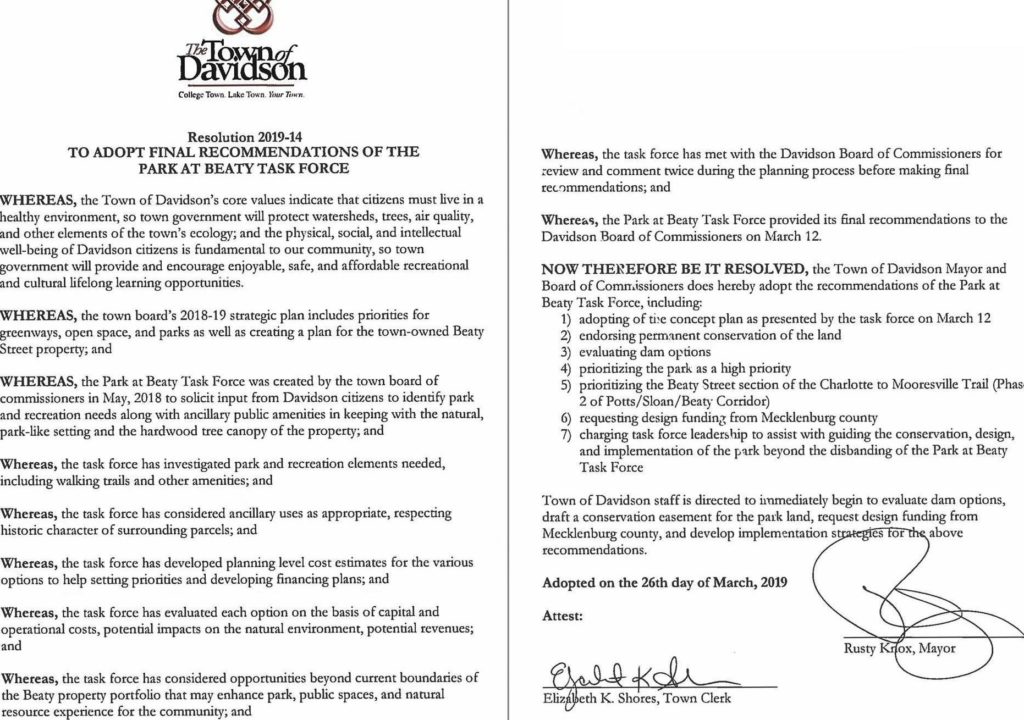
Finally protected from further threat of sale/development, Beaty Park was promptly identified as a “priority” Parks & Recreation project for the Town of Davidson and community – engineering, site work, design, budgeting/grants and numerous other projects by the Town and Davidson Lands Conservancy to restore the Beaty Pond, improve the property, add sidewalks/multi-use paths on Beaty Street for pedestrian mobility and begin implementing public amenities across the approx. 20-acre property – a legacy conservation and ecological asset just minutes from downtown Davidson that can be enjoyed by citizens across the community for generations to come! Beaty Park had to be saved twice by the community; in the process of finally making it the “promised Park” (as referenced by Save Davidson member and resident Barbara Hauser), citizens led a historic movement to save the Town from losing sight of its own adopted core values, improve public process and transparency, and uphold principles that make Davidson such a special place to live – or more simply in the words of Mayor Knox, “Do the right thing!”
A quiet groundbreaking ceremony for the official plans approved by the Town board, as delivered by the “Park at Beaty Street Task Force,” was hosted on the Beaty property by Town of Davidson elected officials, staff, and a handful of residents on December 14, 2021. Funding for Beaty Park came primarily from Town parks and recreation budget funds, including the bonds approved by voters in 2017, as well as several other municipal grants including a NC State PARTF grant.
18 months later, on July 8, 2023, the Town held a long-overdue official Beaty Park public grand opening and ribbon-cutting following completion of major Phase 1 improvements; many aspects of the park planning, design, and development were delayed due to the COVID pandemic in 2020. Although some residents of Hobbs Hill and NoMa attended the grand opening, as a group, the leaders of Save Davidson and those neighborhoods stayed quietly out of the spotlight, providing an opportunity to celebrate the efforts of many groups of Beaty Park supporters who had joined together since 2017 to “make the park” after it was saved. These groups included the Davidson Lands Conservancy, Davidson’s Parks & Recreation staff, and various organizations tasked with building out the park (Dodd Architects, JD Goodrum, Citizen Design, Recreational Resources Services, and Davidson Garden Club). In 2024-2025, additional “Phase 2” improvements at Beaty Park have continued, including improvements to Beaty Pond, ADA access, a fishing pier, and the installation of the outdoor art feature “Bouquet for Davidson” by artist Andy Dunnill.
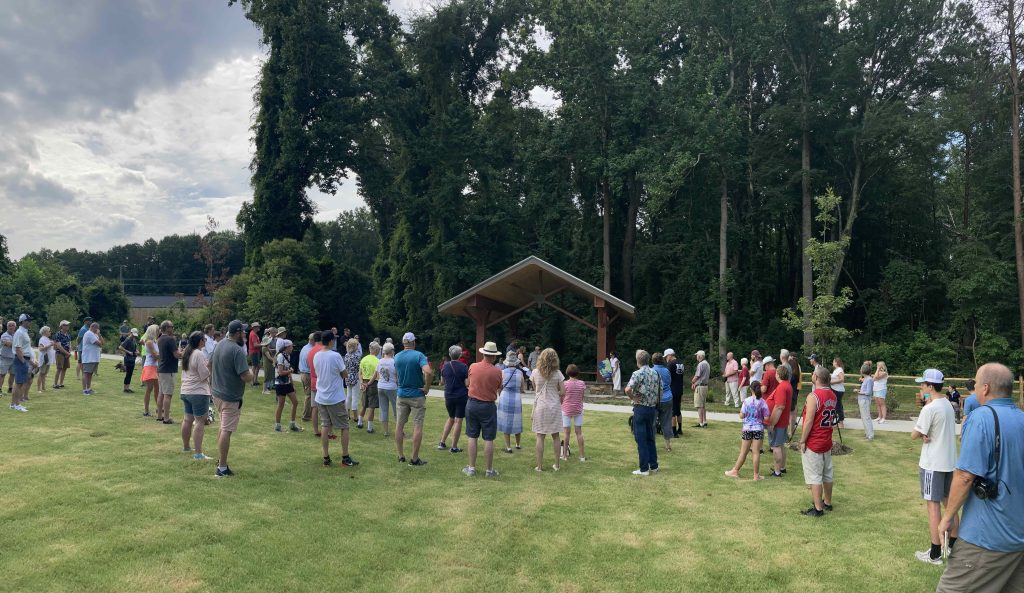
Today, Beaty Park stands as the only dedicated public conservation park lying within greater downtown Davidson and Davidson’s original historic 1879 town limits. It has become both a valued community resource for residents and visitors alike and a lasting example of what can happen when residents demand transparency, accountability, and follow-through on public commitments. As former Commissioner and attorney Jim Fuller later remarked, Beaty Park represents something akin to “Davidson’s Central Park.” And while Beaty Park exists today, and for future generations, thanks to community-wide efforts over 40 years, without the foundational work of Hobbs Hill Neighborhood and its residents, the park and its natural assets would have been lost forever. Thousands of visitors now enjoy Beaty Park each year – most do not know this history. But observing wildlife use the habitat, seeing full parking lots, and watching people explore the nature trails, walk the gardens, fish in the pond, host birthday parties in the active zone, or play with their children on the playground- all help make the untold efforts worthwhile, and prove that saving Beaty Park was always about the entire Davidson community.